RUPP · MITE COHORT 19 · IOT RESEARCH PROJECT
Safer drives begin with earlier warning
DrowsyGuard is a low-cost, camera-based driver drowsiness detection system that runs locally on an ESP32-S3. It observes eyelid closure, blink duration, yawning and head movement, then gives the driver an immediate spoken warning.
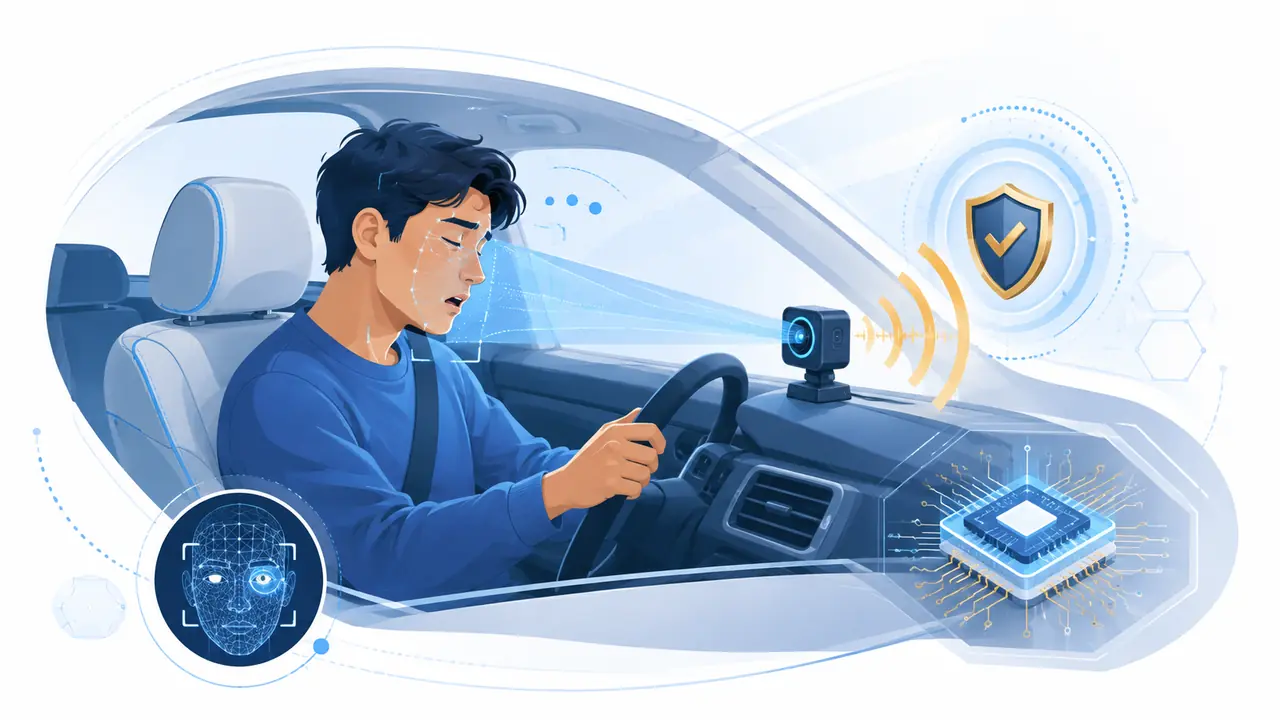
There is no cloud dependency and no display to distract the driver. The board raises its own Wi-Fi access point for diagnostics, while the safety-critical audio alert remains local and continues to work when the dashboard is closed.
Detection stays on the device. What can optionally leave it is a one-line summary of each confirmed alert, published to an MQTT broker so that a fleet can be watched from the fleet monitor — off by default, and structurally incapable of stalling the detection loop. See Fleet alerting over MQTT.
Research prototype
DrowsyGuard is a thesis research project. It is not a certified automotive safety device and must not be relied on to keep anyone awake. See Security and safety.
What it does
camera -> YuNet face + 5 landmarks -> crop both eyes (32x32)
       -> eye-state model: P(closed) per eye        -> PERCLOS
       -> face geometry: jaw drop, head pitch, roll -> yawn / nod
       -> behaviour fusion                          -> risk score
       -> RiskFilter (sustained + cooldown)         -> spoken alert
                                                    -> SD-card capture
                                                    -> MQTT alert (optional)
Risk is measured from eyelid closure over time, not from a whole-face "does this look drowsy" classifier. A face classifier trained on DDD learned to recognise drivers rather than drowsiness; eye closure is the mechanism itself, and it is cheaper on device — the model input is a 32×32 eye patch.
Where to start
-
Install the desktop toolkit, run the live dashboard against a webcam, and flash the board. No hardware needed for the first two.
-
Read the academic scope, objectives, methodology, evaluation plan and team details, or download the complete A4 Word proposal.
-
From unopened parts to a working system: four components, seven wires, eleven labelled diagrams and a per-component test plan.
-
The firmware dev loop, the live dashboard, dataset preparation, training and export.
-
The device HTTP API, the dashboard API, every CLI subcommand and the Python modules behind them.
-
Training YAML, the firmware headers that hold every pin and threshold, and the environment variables
plxy.shreads. -
Deployment, the on-device compute budget, and the documentation pipeline.
Target hardware
| Part | Choice | Why |
|---|---|---|
| MCU | ESP32-S3-WROOM-1 N16R8 | 16 MB flash, 8 MB octal PSRAM — the camera framebuffers and ESP-DL models both live in PSRAM |
| Camera | OV5640 on the DVP/FPC connector | the board is sold as OV3660; units ship with an OV5640, so both drivers are pinned |
| Audio | MAX98357A I²S amplifier + 4 Ω / 3 W speaker | spoken warnings, no display to read |
| Interface | the board's own Wi-Fi AP | join DrowsyGuard-XXXXXX, open http://192.168.4.1/ |
| Runtime | ESP-IDF + ESP-DL | INT8 .espdl models |
The whole build is seven wires: five to the amplifier and two to the speaker. The camera is a ribbon and the interface is a web page, so neither needs any.
Behaviours, not just eye closure
Eye closure alone is not drowsiness, so the risk score fuses four cues
(src/drowsyguard/behavior.py):
| Cue | Weight | How it is measured |
|---|---|---|
| PERCLOS | 0.55 | fraction of recent frames with eyes closed |
| Long/slow blinks | 0.20 | closures over 0.4 s, and microsleeps over 1.0 s |
| Yawning | 0.15 | jaw drop held above the driver's baseline for 1.2 s |
| Head nodding | 0.10 | downward pitch excursion returning within 1.5 s |
The geometric cues come from the five landmarks already available, so they add no model weight. Each is measured against a rolling per-driver baseline, so face shape and camera angle cancel out rather than becoming signal — the same mistake that sank the whole-face classifier.
Unvalidated timings
The yawn/nod thresholds in behavior.py are literature-informed
defaults, not tuned on labelled video — this project has none yet. Their
logic is unit-tested against synthetic traces; treat the event detectors as
unvalidated on real drivers. yaw is computed but not validated.
Project memory
PROJECT_STATE.md, ROADMAP.md and CHANGELOG.md live at the repository root
and are the running record of what has been tried. Read them, and the
handoff protocol, before major changes.